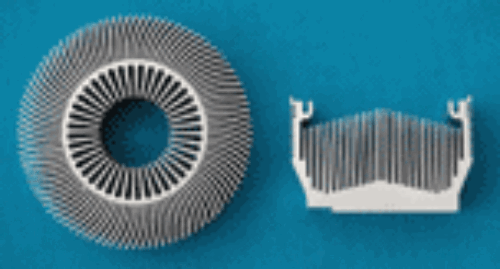
When a high-power electronics system starts running hotter than its thermal design intended, the conversation usually turns to the heat sink. More fins. Better airflow. Maybe a different base material. But one variable that does not always get the attention it deserves is how those fins are actually attached to the base.
That connection point, the interface between fin and base, is where heat sink designs either succeed or quietly fall apart under demanding conditions. For high-power applications, the difference between a bonded fin and a brazed heat sink is not just a manufacturing detail. It is a performance decision with real consequences for thermal resistance, structural integrity, and long-term reliability.
Both approaches can produce high-density fin arrays capable of handling serious heat loads. Both are used across demanding industries including power electronics, EV systems, aerospace, and industrial automation. But they are not interchangeable, and treating them as such is one of the more common mistakes made early in the thermal design process.
This post takes a direct look at bonded fin vs brazed heat sinks, how each is made, where each performs best, and which construction method is better suited for high-power applications where thermal performance and reliability are non-negotiable.
How Bonded Fin Heat Sinks Are Constructed
Bonded fin heat sinks are assembled by inserting individual fins, typically folded or extruded aluminum or copper strips, into grooves or slots machined into a base plate, then securing them with a thermally conductive adhesive.
The Role of Thermally Conductive Adhesive
The adhesive used in bonded fin construction is engineered to maximize heat transfer at the joint, but it introduces a measurable layer of thermal resistance that a metallurgical bond does not. Thermally conductive epoxies commonly used in bonded fin assemblies typically have thermal conductivity values in the range of 1 to 4 W/m·K. By comparison, aluminum has a thermal conductivity of approximately 150 to 200 W/m·K depending on alloy. That gap matters when heat flux is high and every fraction of a degree at the junction counts.
Fin Density Advantages of Bonded Fin Design
Where bonded fin construction excels is fin density. Because fins are inserted individually rather than formed as part of a continuous extrusion, bonded fin designs can achieve aspect ratios of 20:1 or higher, meaning very tall fins packed closely together. This creates significantly more surface area within a given footprint, which is a meaningful advantage for forced-air cooling scenarios with sufficient airflow to take advantage of the increased fin count.
How Brazed Heat Sinks Are Constructed
Brazed heat sinks are manufactured by joining fins to a base plate using a brazing process. A filler metal with a lower melting point than the parent materials is used to create a bond at the fin-to-base interface. For aluminum assemblies, vacuum brazing is a common method, where the entire assembly is heated in a controlled furnace environment that melts the braze filler and creates a continuous metallurgical joint without oxidation.
The Brazing Process and Metallurgical Bond
The key advantage of brazing is that it creates a joint whose thermal conductivity approaches that of the base metal itself. There is no adhesive layer introducing additional resistance. Heat flows from the base plate into the fin with minimal impedance at the interface, which is exactly what you want in high-power heat sink applications where thermal resistance must be minimized at every layer of the assembly.
Material Combinations in Brazed Assemblies
Brazed heat sinks are most commonly produced in aluminum, but copper brazed assemblies are also used in applications requiring the highest possible thermal conductivity. Hybrid constructions, such as copper base plates with aluminum fins, are possible in certain fabricated and brazed configurations for applications with very specific performance and weight requirements.
Thermal Performance Comparison
Interface Thermal Resistance: The Critical Difference
This is the central performance distinction between the two construction methods. Brazed heat sinks consistently deliver lower fin-to-base thermal resistance than bonded fin designs because the braze joint has no organic adhesive layer limiting heat transfer. For high-power heat sinks managing significant heat flux, that lower interface resistance translates directly into lower component junction temperatures and longer device life.
Heat Flux Handling at High Power Levels
In applications where power densities are high and junction temperature margins are tight, such as traction inverters, high-frequency power converters, and laser diode arrays, the thermal resistance advantage of brazed construction is not a minor detail. It can be the deciding factor between a thermal design that meets its targets and one that does not.
Mechanical Durability and Environmental Considerations
Brazed heat sinks also have a durability advantage in mechanically demanding environments. The metallurgical bond is inherently stronger than an adhesive joint and is not subject to degradation from thermal cycling, vibration, or exposure to elevated temperatures over time. Bonded fin assemblies, while adequate for many applications, can experience bond degradation at sustained high temperatures, particularly when the adhesive is repeatedly stressed through thermal expansion and contraction cycles. For aerospace, defense, and heavy industrial applications where long service life under harsh conditions is required, brazed construction is typically the preferred approach.
Cost and Manufacturing Lead Time
Bonded fin heat sinks are generally less expensive to produce and can be assembled more quickly, making them a practical choice for moderate power levels, budget-sensitive designs, or applications where the adhesive bond limitation is not a meaningful constraint. Brazed heat sinks involve more controlled manufacturing processes, including furnace cycle time and tighter process controls, which contributes to higher unit costs. For high-power or high-reliability applications, that cost difference is usually justified by the performance and durability return.
Which Is Better for High-Power Applications?
For most high-power heat sink applications, brazed construction is the stronger choice. Lower interface thermal resistance, superior durability under thermal cycling, and better performance at elevated temperatures make brazed heat sinks the more reliable long-term solution when the stakes are high. Bonded fin designs remain a legitimate option for moderate power levels, high fin density requirements in controlled environments, and cost-sensitive programs where the thermal margin allows for the added interface resistance.
Choosing the Right Construction Method for Your Design
The right answer for your application depends on your thermal budget, your operating environment, and the reliability demands placed on the system over its service life. If you are designing for high power density, harsh conditions, or long service intervals without maintenance, brazed construction deserves serious consideration.
If you are working through a thermal design decision and want to evaluate both options against your specific requirements, our engineering team is here to help. Reach out to discuss your application and get the technical guidance you need to make the right choice before your design is locked in.